


55% of people intending to buy a car in the next six months are using AI models like ChatGPT or Gemini.[1] Chances are, before a customer gets in for a test drive, an AI model has already shaped how they think about the car.
That invites a proverbial look under the hood: When a model stands between you and the next customer, what are the models saying? How are they reshaping the path to purchase? And what can you do about it as a marketer?
Since 2023 we’ve been studying these questions through the Share of Model tool, which measures how brands appear in AI responses.
AI is reshaping the way brands are discovered, compared and purchased. Traditional search is now a conversation with AI moving us from a world of short keywords to longer prompts, where people add more context and nuance to the questions they ask.
Planning for Context
Conversations and prompts provide context about who a person is, what they’re looking for, and what matters to them. That context can also change as the conversation evolves.
Across the funnel, context matters. Just as a salesperson will change their recommendation as they get more information about a customer’s needs, AI models like ChatGPT and Gemini do the same.
While keywords provide aggregate insight, prompts fragment discovery, requiring a different approach to understanding opportunities across the journey.
The Context of Buying a Car
Research we previously shared in Harvard Business Review showed how AI models don’t always interpret brand signals as people do, with interesting implications for luxury brands – including automotive. LLMs can scramble automotive luxury hierarchies – flattening distinctions between brands such as Ferrari and BMW, while luxury cues that helped Mercedes-Benz could actually hurt Porsche. It was an early indication that the signals automakers and dealers rely on to communicate prestige may not translate when AI becomes the intermediary.
To further understand how context affects the car buying journey, we used Share of Model to measure how ChatGPT and Gemini responded as context changes. The context shifts from when a buyer is just starting out, looking for inspiration and direction, all the way to the moments when they’re looking for the test drive and even evaluating their decisions.
As AI becomes the gatekeeper at each stage of the car buying journey, context shifts can inform your automotive marketing strategy.
From the Market to Your Market: Geography’s Impact on AI
At a national level, AI preferences differ from those of prospective buyers. While Toyota remains the #1 brand between consumer preferences and AI recommendations, every other brand changes position: Tesla drops from 7th to 21st; RAM moves from 21st to 9th.
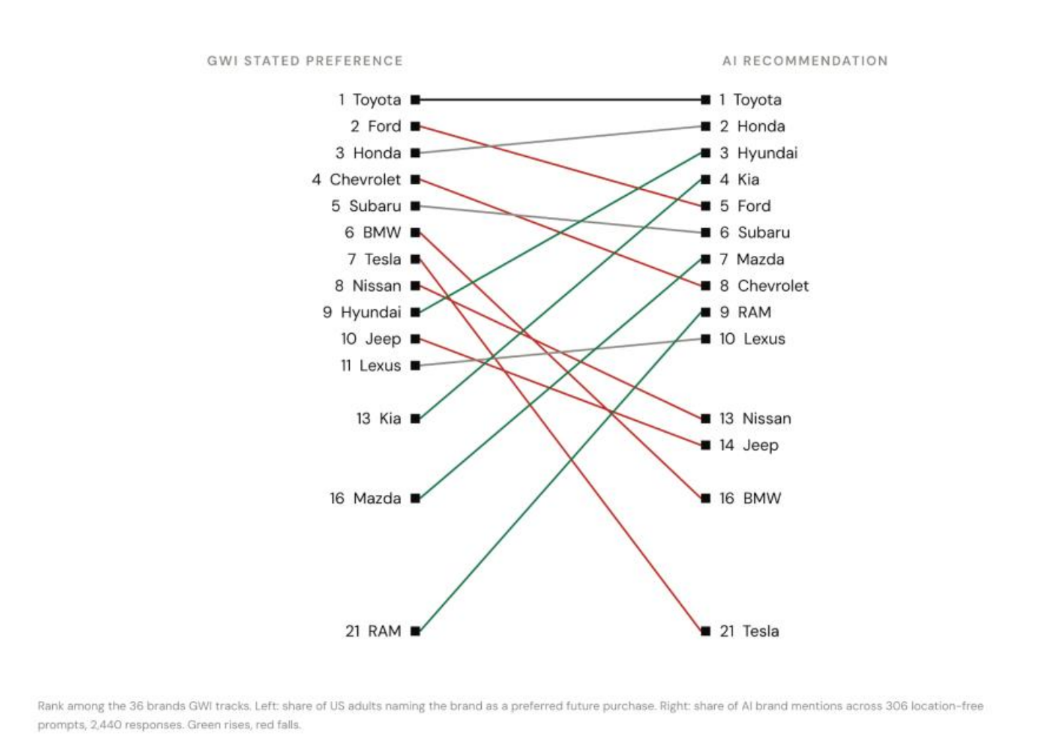
Marketing designed to build brand preference among human audiences is coming up against AI perception. This tension is key for marketers to master as journeys shift.
Location Moves the Dealer, Not the Car
As we apply granular geographic context – from national, to regional, state and local – vehicle recommendations are statistically almost unchanged. The only query that differs by location asks for a unique suggestion (“what should I be driving here that I wouldn’t need anywhere else?”). Overall, AI treats vehicle selection independent from location.
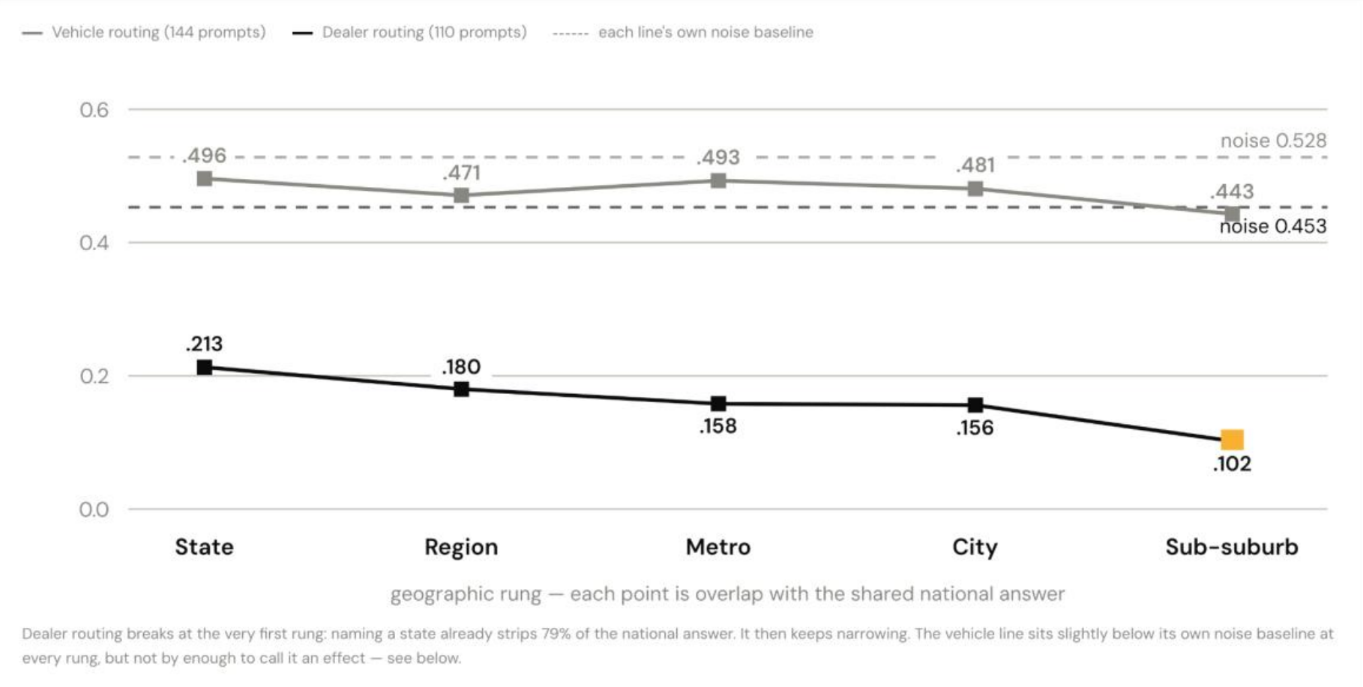
When it comes to dealers, it’s a very different story. As the question moves from national to local, the proportion of local dealerships in the answer rises sharply, from 3% to 45%. The dealerships also recommended change at each level: state and region share 7% of their names, metro and city just 3%, while state and local answer share only 0.4%.
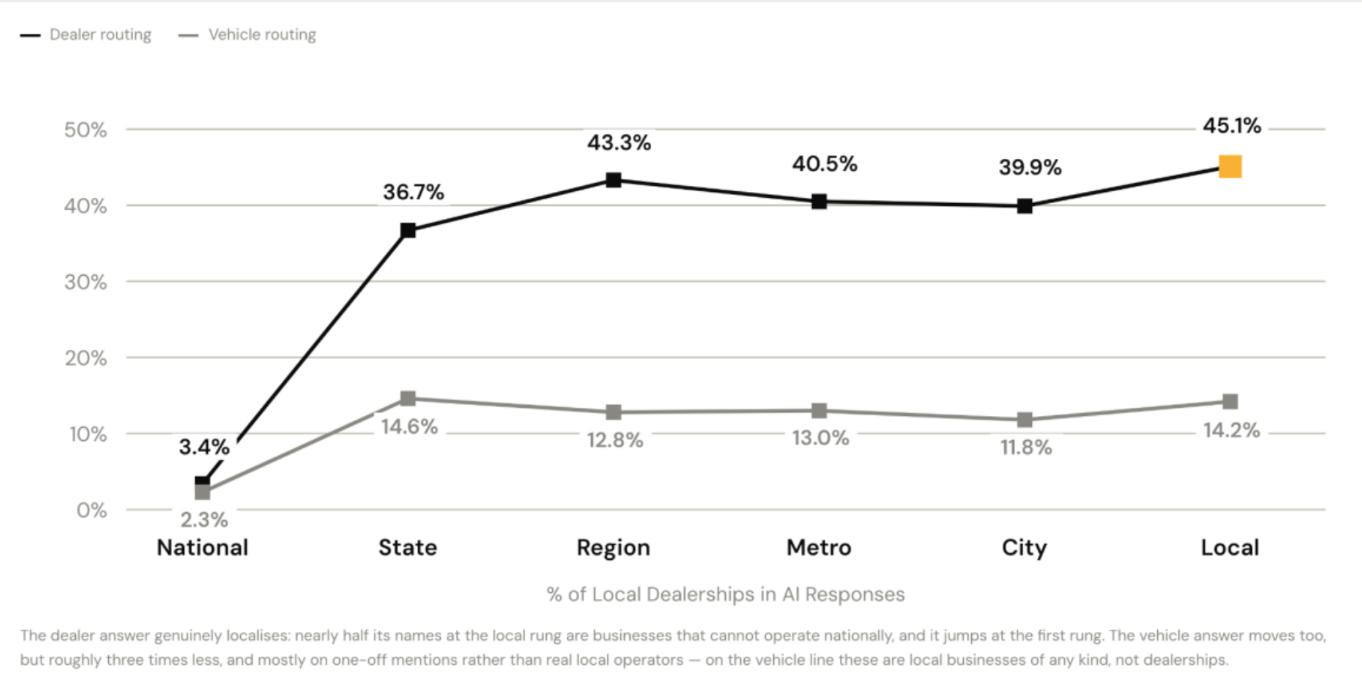
For dealership marketers, the competitive set is different at every geographical level. A regional group competes at state and metro; a single rooftop competes at city and below. Understanding which competitors actually appear alongside you, and how AI models impact the journey is critical.
The Test Before the Drive
Search gave marketers one answer to compete for: a ranking on a page of results. But now, context shapes the response. Ask the same question as a parent, a commuter or a small business owner and seven in ten of the cars named change. Ask it nationally or in Somerville and the dealers change almost entirely. There is no one answer to optimize against. There is a matrix of contexts, and the buyer fills it in, not you.
As AI models gain more context about their users, these persona filters will become increasingly important. The brands that do well will be the ones that already know which contexts they win or lose today, and are prepared for AI journeys to impact decisions before buyers ever step into a dealership.
[1] GWI USA Q3 2025 – Q2 2026
Related Stories:
 John Dawson is VP Strategy at